
U.S. Supreme Court Rules Race-Conscious Admissions at Harvard and University of North Carolina at Chapel Hill Unconstitutional
The U.S. Supreme Court ruled on Thursday that the race-conscious admissions policies of Harvard University and the University of North Carolina at Chapel Hill are unconstitutional, overturning long-standing legal precedent. The majority opinion, written by Chief Justice John Roberts, held that such policies lack sufficiently coherent goals but allowed universities to consider the specific impact of race on an individual's experience in application essays. Reactions from higher education were mixed, with President Biden calling for continued attention to adversity, and the Department of Education planning to issue guidance on lawful admissions practices within 45 days.
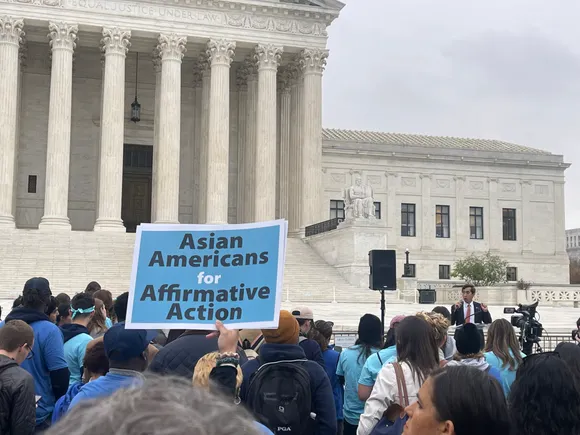
The U.S. Supreme Court ruled on Thursday that Harvard University and the University of North Carolina at Chapel Hill's consideration of race in admissions is unconstitutional. This ruling breaks decades of legal precedent and will profoundly affect college admissions and enrollment patterns for years to come.
Higher education circles widely anticipated that the Supreme Court's conservative bloc would restrict race as a factor in admissions—a practice first deemed legal in the 1978 case 'Regents of the University of California v. Bakke.' Nevertheless, the majority opinion written by Chief Justice John Roberts on Thursday dealt a heavy blow to admissions officers, university administrators, high school counselors, and racial advocacy groups. They fear this ruling will send a discouraging message to marginalized applicants, implying they are unwelcome in higher education.
Legal scholars and higher education leaders emphasized on Thursday that they are still studying the 237-page ruling and considering how to apply it on campus. In the majority opinion, Roberts seemed to leave some room for university admissions offices to acknowledge how a student's racial background contributed to their hardships or shaped their character, but he also wrote: 'Universities may not simply establish through application essays or other means the system we today hold unlawful.'
In fact, most universities do not rely on race as an admissions factor because they admit most or all of their applicants. Therefore, only a few elite institutions may need to adjust their admissions policies. But in any case, when admissions offices consider race, it should never have been the sole criterion for admission—previous precedents had already deemed that illegal.
Although legal details remain to be clarified, the immediate reaction from higher education is unanimous: despite the ruling stripping away a core tool for promoting diversity, institutions will continue to commit to fostering campus diversity. Advocates say the other tools available remain numerous.
Similar sentiments were expressed at the highest levels of the federal government. Hours after the ruling, President Joe Biden called on universities to consider the 'adversity' applicants have overcome, such as socioeconomic hardship or experiences of bias. 'Discrimination still exists in America,' Biden said in a televised address. 'Today's decision does not change that. We cannot let this decision be a permanent setback for the country.'
However, whether this ruling will truly motivate the risk-averse higher education sector remains to be seen. Dominique Baker, a professor of education policy at Southern Methodist University, said Thursday: 'No university wants its name on the next Supreme Court case.'
What did the ruling say?
The conservatives dominating the Supreme Court were drawn to the arguments of the legal group 'Students for Fair Admissions' (SFFA). The group filed two lawsuits accusing the University of North Carolina at Chapel Hill of favoring Black and Hispanic applicants and accusing Harvard of discriminating against Asian American students.
'The opinion issued today by the U.S. Supreme Court marks the beginning of the restoration of the colorblind legal covenant that binds together our multiracial, multiethnic nation,' SFFA President Edward Blum said in a statement Thursday.
Lower courts had previously upheld these two highly selective institutions. But the Supreme Court found that the universities' admissions processes violated the equal protection guarantee of the Fourteenth Amendment to the U.S. Constitution. The ruling applies to most private universities because they receive federal funds.
In the majority opinion, Roberts framed university admissions as a zero-sum game—when students of one ethnicity benefit, it comes at the expense of their peers. Such harmful stereotypes do not justify universities' attempts to diversify their student bodies. Diversity may bring educational benefits, such as fostering engaged citizens, but Roberts called these goals 'unmeasurable.'
'While these are commendable goals, they are not coherent enough for strict scrutiny,' Roberts wrote. 'It is unclear how courts are to measure these goals, or whether they can be measured at all.'
In Thursday's opinion, the Supreme Court's conservatives wanted to know when race-conscious policies could end—Roberts repeatedly referenced the theoretical timeline predicted in the 2003 case 'Grutter v. Bollinger.' That case upheld the University of Michigan's race-conscious admissions policy. Former Justice Sandra Day O'Connor, writing for the majority in that case, predicted race-conscious practices would no longer be necessary within 25 years, though she later expressed regret over that phrasing.
'Twenty years have passed since Grutter, and race-based college admissions remain without an end in sight,' Roberts wrote.
Nevertheless, the Supreme Court ruled that universities are not completely barred from considering race. Roberts wrote that universities can actually examine how race has affected an applicant's life, 'provided that the discussion is concretely tied to a particular character trait or unique ability the applicant can contribute to the university.' But at the same time, Roberts warned universities not to try to circumvent the new ban on race-conscious admissions through means such as application essays.
Baker said that, in essence, the Supreme Court's conservatives seem to accept interpersonal racism rather than structural racism. Admissions professionals will face the challenge of clarifying these two concepts when making admission decisions.
Justice Ketanji Brown Jackson, the newest member of the Supreme Court, criticized this conservative approach in her dissent. Jackson previously served on a Harvard board and therefore recused herself from the Harvard case. 'Today, the majority pulls the ripcord and announces 'colorblindness for all' by legal fiat with a let-them-eat-cake obliviousness,' Jackson wrote. 'But deeming race irrelevant in law does not make it so in life.'
What happens next?
How universities assess students' race-related experiences within the scope of the new ruling is exactly what higher education needs to address.
Angel Pérez, CEO of the National Association for College Admission Counseling, noted that the Common Application, an online portal used by over 1,000 universities, allows institutions to include short-answer questions. Universities could design a question for that section asking about students' 'life experiences,' he said. 'We're not entirely sure yet,' Pérez stated.
In the meantime, Pérez said the association will help its members—including high school counselors and college admissions professionals—navigate the complexities of the ruling. NACAC will host a series of events to discuss its specific provisions. Pérez said high school counselors are especially concerned about how to guide students applying to university programs designed to benefit marginalized students, such as Black or Latino students.
The U.S. Department of Education also wants to help. In a statement responding to the ruling on Thursday, the department said it plans to work with the Department of Justice to provide universities with a list of lawful admissions practices within the next 45 days. By September, the department will release a report outlining strategies to enhance campus 'diversity and educational opportunity.' The agency also said it will consider whether it can collect and publish more admissions data, such as data 'broken down by race and ethnicity, first-generation status, and legacy status.'
'I want to send a message to all aspiring students, especially Black, Latino, Asian American, Native American, Alaska Native, Native Hawaiian, Pacific Islander, and other students from underserved communities: We see you, and we need you,' Education Secretary Miguel Cardona said in a statement Thursday. 'Do not let this ruling stop you from reaching your educational potential.'
The American Council on Education (ACE), the main lobbying group for higher education, will also host an event for universities on July 6, with its legal team discussing the ruling's impact, said Jessie Brown, ACE's senior vice president and chief of staff. 'Higher education is not monolithic, and although institutions like open-admission universities do not consider race, this decision could affect them,' Brown said. 'We would never suggest that what works for a small liberal arts college applies to a large public institution. There are commonalities, but geography, specific missions—these are crucial, and there are many moving parts.'
Concerns of overcorrection
Baker said the higher education industry is known for reacting slowly to change but quickly to potential litigation. Although institutions expressed dismay over Thursday's decision, Baker said she does not know whether universities will actually advance other diversity efforts.
A common concern is that institutions will overreact to the ruling and scale back programs designed to support disadvantaged students, said Teri Taylor, strategy director for innovation and discovery at Lumina Foundation, a nonprofit focused on higher education opportunity. Although the ruling represents a setback, in Taylor's view it also provides an opportunity for universities to invest in other diversity programs or re-examine admissions efforts beyond race-conscious policies. She cited examples such as staffing admissions offices with diverse personnel or prioritizing visits to high schools in low-income communities.
'We cannot let six people on the Supreme Court's view of this one particular tool stop us from moving forward on some of our work,' Taylor said. She said higher education leaders should also remember that conservative lawmakers are currently trying to dismantle some of higher education's most cherished traditions. Prime examples are Texas and Florida, which have banned diversity spending. Florida Governor Ron DeSantis, a Republican presidential candidate, is battling higher education, including suing the Department of Education over accreditation requirements and proposing to ban academic programs such as intersectionality and gender studies at state public universities.
'This is part of upholding white supremacy,' Baker said. 'We cannot look at the Supreme Court case in isolation.'
The Supreme Court last ruled on race-conscious policies in 2016. SFFA also brought that lawsuit, representing a white student named Abigail Fisher, who claimed the University of Texas at Austin denied her admission because of her race. In that case, 'Fisher v. University of Texas,' the justices narrowly upheld the university's race-conscious admissions program. Justice Anthony Kennedy, who wrote the majority opinion in that case, supported previous rulings, holding that race-conscious admissions programs may be constitutional if they are narrowly tailored to achieve the educational benefits of diversity. That decision shocked college admission advocates at the time because Kennedy had dissented in the 2003 Grutter case.
History of bans on race-conscious policies
Although Thursday's ruling restricts universities nationwide, some institutions have already faced the consequences of bans on race-conscious policies. Julie J. Park, a professor of education at the University of Maryland, College Park, suggested universities look to the University of California system, which has made progress in increasing the proportion of minority students. This is despite California being the first of nine states to ban race-conscious practices over the past 25 years. After California abolished race-conscious admissions in 1996, the proportion of Black and Hispanic students immediately declined. The impact of the ban persists; last year, a peer-reviewed study found that underrepresented students shifted to 'lower-quality universities.' The University of California system has also spent $500 million on diversity efforts and outreach to try to mitigate the harm of the ban, but most universities do not have those resources.
'This is all just a sad moment in higher education,' Park said.