
Five Years After Nearly Closing, Hampshire College Is Gradually Moving Toward Financial Sustainability
After the 2019 financial crisis, Hampshire College has gradually restored enrollment and financial balance by eliminating traditional departments, focusing on global issue curricula, and launching a $60 million fundraising campaign. President Edward Wingenbach expects to eliminate the budget gap by 2026. Experts believe its principle of 'focused distinctiveness' can be adopted by other institutions.
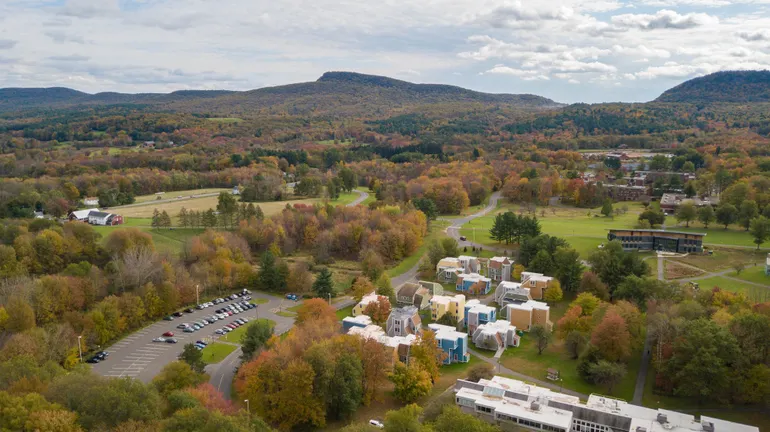
Five years ago, Hampshire College, a private liberal arts college in western Massachusetts, seemed destined for a different fate. The 54-year-old college was on the verge of closure due to financial difficulties, and even decided not to enroll a full incoming class—appearing poised to shut down like many small private nonprofit institutions in recent years.
But since the financial crisis of 2019, college leadership has guided Hampshire onto a path toward financial viability. The college launched a $60 million fundraising campaign, redesigned its curriculum, and fully committed to what President Edward Wingenbach calls one of the "most distinctive and interesting missions" in higher education: it is an institution designed totransform higher education, an experimental college, Wingenbach said.
This means eliminating majors and departmental divisions, instead offering courses focused on solving urgent world problems such as climate change and racial injustice.
"If we want to succeed as an independent institution and reverse financial challenges, we must fundamentally adhere to our mission and revitalize Hampshire's distinctiveness," Wingenbach said.
Michael Horn, a higher education expert, podcast host, and book author, said Hampshire's trajectory appears to be moving in the right direction. The college's enrollment has begun to rebound over the past few years, and it has made progress in eliminating its annual deficit.
In recent years, other private colleges have not succeeded in reversing severe financial difficulties. These include Massachusetts'sPine Manor College, which announced in 2020 it would be taken over by nearby Boston College; also in Massachusetts,Mount Ida College, which closed suddenly in 2018; andIowa Wesleyan University, which closed last year.
Now, other college leaders are trying to learn from Hampshire's experience and discuss changes before they themselves fall into financial crisis, said Mary Marcy, a higher education consultant and former president of Dominican University of California.
"Places like Hampshire are indeed turning around, which is an encouraging signal," Marcy said.
Curriculum Reform
Hampshire's success may provide a roadmap for other small colleges facing financial problems. But its transformation process was not easy.
At the core of the college's plan is an experimental curriculum focused on solving urgent world problems rather than teaching standalone majors. To this end, Hampshire eliminated its interdisciplinary schools, which were similar to departments, Wingenbach said. This means faculty are no longer affiliated with a single disciplinary field.
While implementing the plan, the college was forced to launch a fundraising campaign, which Wingenbach compared to a "political campaign," to keep the college running.
"We told people that what we are doing is exciting, unique, interesting, engaging, and sets an example for higher education, and you should support it," Wingenbach said. He said this vision helped drive donations and the arrival of prospective students.
To eliminate the structural deficit, the college needed to cut programs that were not "mission-centered," Wingenbach said.
For example, Hampshire terminated independent research centers that did not offer courses for undergraduates. Officials also suggested that its development office focus entirely on raising funds for direct, unrestricted operational support—rather than planned giving—giving the college freedom to decide how to use the funds.
These changes have brought new opportunities for students. Last year, the college created an optional course structure called"Semester Unbound", where students devote an entire semester to a course built around a large project. Last fall, students developed a multi-year climate action plan for Hampshire.
Through this program, students have "great flexibility to travel, do intensive work, and are not constrained by the traditional classroom calendar structure," Wingenbach said.
Hampshire economics professor Omar Dahi, who is also the college's representative for the American Association of University Professors chapter, said individual faculty had already adopted many of the ideas, practices, and expectations embedded in the new curriculum. This includes integratinganti-racist teachingorentrepreneurial skillsinto every student's educational experience.
Through these changes, Hampshire sends a message to prospective students: if you care about climate change, if you care about resisting white supremacy, if you want to understand how to "conceptualize truth in a post-truth era," you can do this work at Hampshire College and be part of a community engaged in such work, Wingenbach said.
Gaining Faculty Support
From a faculty perspective, the 2019 crisis was "extremely destructive" and a "huge shock," because professors worried they would soon lose their jobs, Dahi said.
After the 2019 crisis, many faculty left the college, including those who wanted to stay, Dahi said. Although no faculty were laid off, they accepted negotiated leaves and some temporary salary reductions, he said.
Hampshire leadership reduced the number of full-time equivalent faculty from 118 in the 2018-19 academic year to just 65 the following year. By the 2022-2023 academic year, the total faculty count fell to a low of 45—although it has slightly rebounded to 50 this academic year.
Dahi himself took two years of unpaid leave to "participate in actions to save the college"—he took a temporary funded position at nearby University of Massachusetts Amherst before returning, he said.
Faculty also had to confront the end of the college's interdisciplinary school structure, including the elimination of the long-established schools of social science and natural science, Dahi said.
Each school had "its own norms and ways of doing things, and you felt that was your home," he said.
However, faculty also take pride in helping save the college, Dahi said. Goodwill has developed between faculty and Wingenbach, who took office in the summer of 2019 after Miriam Nelson resigned earlier that year.
Dahi said that after the crisis, Hampshire's management has been more transparent than college leaders he had seen in the past, when decisions were often arbitrary, he added. This has helped build trust, even when decisions are not universally popular, he said.
"People can at least build a trust that decisions are made based on logic and predictable things," Dahi said. "That is a major shift."
However, Marcy said colleges do not need to be on the verge of closure to gain faculty support for transformative reforms.
The key is that Hampshire's reforms align with its historical mission, Marcy said. For example, they did not give up everything and go fully online.
How Far Is Hampshire from Financial Viability?
Hampshire's admission rates and financial situation have been moving in the right direction.
According to data provided by the college, 724 students enrolled at Hampshire last fall—a 59.5% increase from 454 students in fall 2021. In fall 2018, before the financial crisis, 1,126 students were enrolled.
Meanwhile, the college received 2,411 applications in the 2023-24 academic year, an 82.7% increase from fall 2020. This figure is roughly on par with pre-crisis levels in 2018.
Wingenbach expects about 900 students to enroll next year and about 1,000 the year after.
Wingenbach said he believes the college will be able to eliminate its budget gap by 2026. At that point, the college will be fully sustainable on tuition revenue, regular annual funds, typical fundraising, and regular endowment distributions, Wingenbach said.
According to the college, this year's budget deficit—the amount drawn from the sustainability fund—is $3 million, far lower than the $9 million in the previous academic year.
To bridge the budget gap, Hampshire has raised more than $40 million in unrestricted cash and pledges since the 2018-19 academic year to support college operations until it transitions into a sustainably sized institution, Wingenbach said.
Can Other Colleges Follow Hampshire's Model?
Horn said Hampshire's specific approach is unique, and he is not sure there is room in higher education for a dozen similar colleges. But the general principles it follows can apply to any institution—strengthening its own differentiation, clarifying what attracts students, and being clear about that, he said.
"This is a set of strategies anyone can and should follow," Horn said.
As president of Dominican University of California from 2011 to 2021, Marcyoversaw similar changes. The university's plan took about five years, streamlined the curriculum, made it easier for students to pursue double majors or double minors, and ensured all students had certaincore experiencessuch as integrated tutoring and community engagement during their time there, she said.
Under her leadership, Dominican University of California's graduation rates and fundraising significantly improved.
Marcy believes college leaders should ask themselves: If we were creating this institution today with the same values and mission, what would it look like?
"Then you have great freedom to reimagine," Marcy said.
But she said that when investing in such transformations, they also need to determine the resources and time needed for success.
"Places like Hampshire are indeed turning around, which is an encouraging signal."

Mary Marcy
Higher Education Consultant
One factor in Hampshire's success is that officials realized they "cannot be all things to all people," Horn said. "You have to play to your strengths and, frankly, avoid your weaknesses."
This can reduce administrative overhead and cut "extraneous" costs that affect financial sustainability, he said. It can also reduce the need to maintain departments unrelated to the college's core mission. It also clarifies who the institution serves—ultimately serving those students better, Horn said.
A few years ago, when typing "Hampshire College" into Google, suggested searches included: "Is Hampshire College still open?" Wingenbach said.
Now they receive a number of applications comparable to before the financial crisis, and the quality of applicants is "equally good or better, more diverse, from a wider range of states or countries," he said.
"This is because people are excited about a curricular approach that no one else has adopted but that captures the value of a liberal arts education," he said. "The students we ultimately enroll absolutely find this approach compelling."