
Beyond School Colors: How College Town Hotels Attract Guests with Unique Experiences
College town hotels are attracting students, families, and sports fans through immersive campus culture design, community partnerships, student staff, and sustainable amenities. However, amid enrollment fluctuations and industry uncertainty, operators are also exploring flexible strategies.
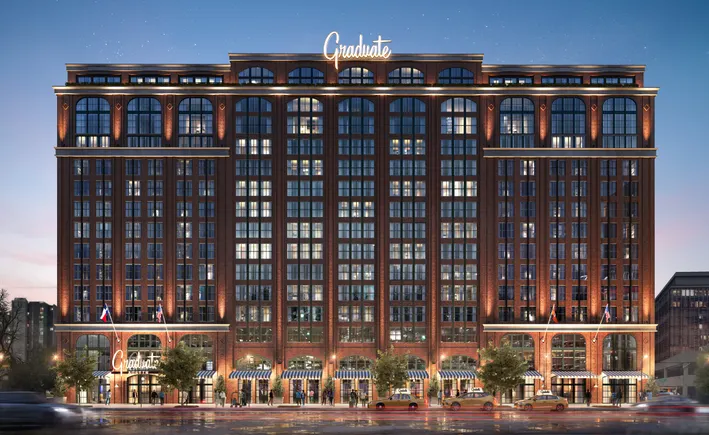
With blue-and-white checkered soft furnishings, reclaimed parquet flooring, a basketball-leather-style front desk, and an oversized husky mascot statue, the Graduate by Hilton Storrs Hotel offers guests a fully branded stay near the University of Connecticut's main campus. In 2020, the former Nathan Hale Inn was expanded and completely renovated, transforming into a residence that blends elegance and style while paying homage to UConn's New England heritage and athletic prowess.
The Storrs Hotel is one of nearly 40 on-campus or near-campus properties under the Graduate by Hilton brand, which was acquired by Hilton earlier this year for $215 million. Graduate by Hilton is just one of several hotel groups investing heavily in or specializing in college-town properties, including Brick Hospitality Group, Charlestowne Hotels, and Scholar Hotels. Amid fluctuating enrollment numbers and shifting guest preferences, these brands are leveraging engaging decor, tailored stay-and-play packages, and local talent to attract students, families, sports fans, and other campus visitors.
"Weaving a fun and vibrant campus lifestyle together with a safe and welcoming environment sparks excitement and school pride in students while reassuring parents that their children will be well cared for," said Gareth Brown, vice president of operations at Charlestowne Hotels.
The concept of a college-town hotel varies depending on the school it serves, and it continues to evolve as the foundations of both industries shift.
Growing in tandem with the community
The Graduate by Hilton Storrs Hotel is not the only college-town property forging a deliberate connection with its higher education neighbor—and vice versa.
In Waterville, Maine, Charlestowne-managed Lockwood Hotel, with 53 rooms, reflects Colby College's commitment to its community. The $26 million property was developed by the college itself, briefly used as transitional student housing during the pandemic, and opened to the public in 2022, marking the first new hotel in downtown Waterville in over a century, according to Mainebiz. The hotel is a key pillar of a $200 million public-private partnership led by Colby College and other local stakeholders aimed at helping this declining industrial town recover from decades of underinvestment, as reported by Inside Higher Ed.
An immersive experience when staying on campus leaves an excellent first impression that other types of lodging, such as short-term rentals, cannot match.
The Lockwood Hotel fully embraces Waterville's arts scene, with public spaces showcasing selected works from the Colby College Museum of Art and a lobby featuring wood reclaimed from the nearby Penobscot River, creating a "gallery-like environment," Brown said.
In Clemson, South Carolina, Charlestowne-managed The Abernathy, with 41 rooms, similarly aligns with the branding of its neighboring school. The hotel's decor includes a life-sized statue honoring a beloved late local mayor who taught at nearby Clemson University and championed environmental justice in the region. As a college-town hotel situated in the shadow of an 81,500-seat football stadium, The Abernathy is adorned with Clemson Tigers merchandise. The hotel promotes its support for Clemson athletics and a related charity, offering a $500 "VIP game-day experience" package on football Saturdays.
"An immersive experience when staying on campus leaves an excellent first impression that other types of lodging, such as short-term rentals, cannot match," Brown added.
But college-town hotels—and perhaps the universities themselves—should avoid overly close ties, cautioned Harry Wheeler, principal at Group One, a studio of JCJ Architecture, which worked on the renovation of the Graduate Storrs Hotel.
"Most institutions want the hotel to have its own identity, to operate independently while still being associated with the university," he said. "The hotel is often the first stop for guests arriving on campus, so it forms the university's first impression, and the hotel experience must exceed expectations."
Wheeler noted that a hotel associated with a university that delivers a poor guest experience could negatively impact the school's image. Similarly, a university's missteps can also hurt supportive local businesses—for example, Clemson University insisted on holding its homecoming football game in late September while the surrounding area was still recovering from one of the worst tropical storms in years, as reported by The Post and Courier.
Beyond campus spirit
Even in places where higher education is not the primary draw, university-affiliated hotels understand the importance of attracting and delighting visiting prospective students, families, and fans.
This often begins with a human touch. Many of Charlestowne's college-town properties intentionally hire students for guest-facing roles, creating "an instant personal connection and warmth from the moment guests check in," Brown said. Management encourages student employees to share their own experiences with visiting prospective students and their families, sometimes offering "insider" campus tours, he added.
This extra service is a win-win for both the hotel and the school. "A positive experience at a college hotel is likely to translate into a new student and their supporting family," Brown said.
The Dagny hotel in Boston's Financial District, with 403 rooms, houses classroom space for Northeastern University's College of Professional Studies on its second floor, allowing guests to get a close-up look at campus without a tour guide. But the Dagny also attracts visitors to dozens of other higher education institutions in the greater Boston area through its "Academic Adventure Package," which includes free overnight parking, a $20 Uber credit, and complimentary snacks.
Financial incentives for students are fairly common at college-town hotels. The Beatrice hotel in Providence, Rhode Island, invites students and their families to "go back to school," offering a 10% discount on select dates and a complimentary Bellini cocktail upon arrival. The Lockwood Hotel offers several generous family-friendly packages, most including free meals or dining credits at upscale restaurants. Brick Hospitality, meanwhile, offers "locally negotiated rates" at its properties near campuses to attract visiting families, said Chief Operating Officer Sarah Lynch.
Beyond perks and discounts, incoming students and their families "increasingly value sustainable practices and tech-friendly amenities, such as smart rooms and high-speed internet," Lynch said.
That comes easily for Charlestowne-managed Hotel Marcel. The property in New Haven, Connecticut—a short drive from Yale University, the University of New Haven, and other higher education institutions—recently became the first zero-emissions hotel in the U.S. to earn passive house certification, making it a "pilgrimage site" for environmentally conscious visitors. The hotel just launched a modern take on the traditional wake-up call, featuring celebrities and meteorologists delivering climate change facts, as reported by Ad Age.
"Sustainability is the backbone of the entire Hotel Marcel experience, and it has become a very natural topic of conversation when students and families visit," Brown said.
Navigating an uncertain future for higher education and hospitality
Hilton's merger with Graduate signals that major hotel groups are bullish on campus-adjacent properties. But the higher education industry itself looks more unstable than it has in decades, with small liberal arts colleges facing declining enrollment—some even closing—while seemingly "safe" trade careers are gaining favor among young people skeptical of the high cost of four-year degrees, according to the Society for Human Resource Management.
"The college-town hotel industry faces challenges from declining enrollment, prompting Brick to explore more flexible property uses and potential partnerships with local institutions," Lynch said. She added that Brick's future acquisitions may target mixed-use developments or "flexible properties that can adapt to changing demographics."
Brown noted that small and mid-sized schools often respond more quickly and decisively to shifts in market sentiment because they compete for attention with larger, more prominent institutions. This could lead to deeper partnerships with affiliated hotels or, as in Waterville, more direct involvement in hotel development.
"Research institutions, athletic facilities, and specialized programs often create new opportunities for hotel services, and schools strategically expanding in these areas tend to see growing demand for upscale accommodations," Brown said.
