
New York Governor's Plan to Revitalize SUNY Still in Early Stages a Year Later
New York Governor Kathy Hochul's ambitious plan to revitalize the State University of New York (SUNY) system, announced last January, has seen limited progress after more than a year of implementation. The plan faces challenges such as declining enrollment and funding shortages, with new Chancellor John King seen as a key figure in advancing the initiative.
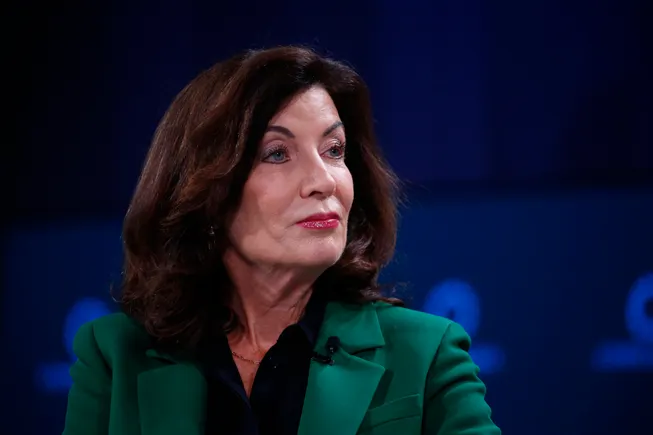
In early January last year, New York Governor Kathy Hochul unveiled a plan aimed at strengthening the state's vast public higher education system, which encompasses 64 campuses, and described it in highly ambitious terms.
Hochul's office said at the time that the plan would be "transformative," a blueprint to ensure that the State University of New York (SUNY) becomes "the best public higher education system in the nation."
However, this vision and its related benchmarks are too idealistic for some higher education scholars.
They question: After SUNY's enrollment fell by more than 20% over a decade, how can its registered student count reach 500,000? After all, the state's traditional college-age student population continues to shrink, and colleges nationwide have not yet recovered from the pandemic-era enrollment collapse.
Additionally, Hochul designated Stony Brook University and the University at Buffalo (UB) as flagship institutions last year, but how can these two schools each achieve $1 billion in annual federal research funding by 2030? The governor has made scattered investments in this area, such as allocating millions for UB's STEM facilities, but the $1 billion target is closer to the research funding levels of renowned institutions like Johns Hopkins University and the University of California, Berkeley.
Higher education experts and faculty leaders say Hochul's goals require substantial public funding to achieve. Since she announced these goals, more than a year has passed with little progress.
Still, Hochul is optimistic about the system's future, especially with former U.S. Secretary of Education and New York State Education Commissioner John King taking over as the new chancellor. She and some observers believe King is the key missing piece to integrate Hochul's plan.
Governor's spokesperson John Lindsay responded via email to questions about the feasibility of Hochul's plan.
Lindsay said: "Governor Hochul has a bold vision to transform SUNY and ensure it becomes the best and most equitable public higher education system in the country. Governor Hochul has announced historic investments in SUNY and welcomes former U.S. Secretary of Education John King as chancellor, who will continue to fully implement the governor's vision for the system."
What problems is SUNY facing?
Although SUNY is the largest comprehensive public higher education system in the United States, it has also been affected by the national trend of declining college enrollment.
Declining birth rates have reduced the number of high school graduates entering the system, but its community colleges in particular have been losing students since the Great Recession. During economic booms, community college enrollment tends to decrease because more job opportunities are available.
Since fall 2012, enrollment at SUNY community colleges has fallen by about 34%, to 159,333 students in fall 2022.
Compounding the system-wide enrollment decline was the onset of the COVID-19 pandemic, which contracted the economy, broke previous trends, and hit community college student numbers the hardest.
Higher education is just showing signs of recovery, with recent National Student Clearinghouse Research Center data showing undergraduate enrollment only slightly down 0.6% from the previous year.
All these complications force SUNY to compete for students—not only within New York's vast higher education market (including prestigious institutions like Columbia University and Cornell University), but also among its own institutions.
Nathan Daun-Barnett, a professor of educational leadership and policy at the University at Buffalo, said SUNY's most prominent institutions, such as UB, have attracted interest from students at other campuses.
Daun-Barnett said UB has weathered the enrollment downturn by admitting slightly weaker students it would not normally accept. But most SUNY institutions do not have that option because they do not lack applicants.
What does the plan entail?
Part of Hochul's strategy is to redefine the roles of institutions within the system, such as elevating UB and Stony Brook University to flagship status.
Investment in these institutions—as well as two other SUNY "university centers," the University at Albany and Binghamton University—remains a major focus of the plan. The University at Albany and Binghamton University are required to secure $500 million in annual research funding.
Nancy Zimpher, who served as system chancellor from 2009 to 2017, said the philosophy is "a rising tide lifts all boats," and all SUNY institutions will ultimately benefit from the four universities' leading national reputations. Zimpher now works at the Association of Public and Land-grant Universities, helping guide its "Systems Innovation" project, a coalition of public institutions aimed at addressing higher education's most pressing issues.
Daun-Barnett said ideally, UB and Stony Brook University would compete with major public research institutions like the University of Michigan.
The University of Michigan's flagship campus attracts large numbers of out-of-state and international students, who typically pay higher tuition. Daun-Barnett said if more such students come to these two New York flagship universities, it would strengthen their financial position, and increased enrollment could spill over to other SUNY institutions.
The system is designing "cascading" admissions, where students rejected by one SUNY institution can be admitted to another.
SUNY's application numbers have increased, but it largely credits a recent two-week application fee waiver program. It announced a "historic" increase in applications for fall 2023—from 97,257 the previous year to 204,437, a 110% increase as of November. SUNY also saw a 70% increase in out-of-state applications.
Hochul and the system are counting on King to maintain this momentum. They praise his experience as federal Secretary of Education and his deep knowledge of the state as former New York State Education Commissioner—although he left the state as an unpopular figure due to his push for controversial K-12 policy reforms.
Hochul's plan changes the way SUNY has operated for years under a "systemic" model that emphasizes its strength as a whole, which was championed by Zimpher.
Zimpher said the governor's ideas do not weaken "systemness" but rather weave different institutions together to leverage their strengths. She said King excels at "collective impact" and is well suited to guide this effort.
Zimpher envisions SUNY guiding students through every stage of their academic careers, from community college to advanced degrees, which she says will require closer cooperation among institutions. Zimpher said SUNY can build such seamless transfer agreements because it is "all under one roof," unlike California, where community colleges must negotiate transfer rules with two separate four-year public systems.
However, concerns have arisen over the research focus and flagship designations, particularly that they will spark more infighting among institutions. Shortly after Hochul announced her SUNY design, two state legislators wrote to her asking that the University at Albany and Binghamton University also be made flagships—or that the system simply have no flagships.
The Haves and the Have-Nots
In some respects, Hochul's plan draws attention to the vast financial disparities among institutions, such as between the newly designated flagships (whose enrollment has remained stable for years) and those with deficits.
Frederick Kowal, president of United University Professions, which represents a large number of SUNY faculty, said at least 19 campuses face "serious financial difficulties."
For example, SUNY Fredonia expects a budget shortfall of up to $16 million.
Kowal said: "There is a class difference between these university centers and the comprehensive colleges and other campuses. I think this is a potential problem."
Hochul's initiative does not establish a fund for these struggling campuses, a program the union has been requesting. She also has not proposed a significant increase in SUNY's general operating budget.
SUNY's decade-long enrollment decline coincided with largely unchanged state support, following Great Recession-era cuts that reflected patterns elsewhere in the United States.
Public higher education leaders across the country often blame insufficient state support for financial woes. For example, observers of Pennsylvania's higher education system point to inadequate state funding as the culprit behind its financial troubles, leading to the recent merger of six of its institutions into two.
UB professor Daun-Barnett said he worries that if financially struggling campuses do not receive state help, SUNY could face similar mergers.
However, King said New York's government under Hochul has made a "down payment" for SUNY.
He noted that Hochul allocated $53 million last year to hire new full-time faculty across 30 campuses, and $60 million to curb enrollment decline and create new academic programs. In her 2024 budget proposal, Hochul proposed an endowment matching fund for the four university centers—UB, Stony Brook, Binghamton, and Albany—where the state would provide $1 for every $2 in private donations, up to $500 million.
Her budget plan maintains community college spending at last year's levels. Under the state's funding formula, community colleges face reduced allocations.
King said: "We are moving in a very good direction."
However, the budget proposal also authorizes SUNY to raise tuition by 3% at most SUNY colleges, or 6% at university centers. University centers can raise tuition for five consecutive years, capped at a 30% increase.
This has drawn concern from some students and college access advocates.
They question whether it is wise for SUNY—a system known for affordability and serving middle-income students—to raise tuition, especially in the wake of the pandemic. Higher prices could further dampen enrollment.
King said the proposed tuition increase is modest, and more than half of full-time students pay no tuition due to federal Pell Grants or state aid. New York recently expanded one of its financial aid funds, the Tuition Assistance Program, making part-time students taking 6 to 11 credits eligible for support.
He said he still believes Hochul's goals, including the 500,000-student enrollment benchmark, are achievable "over time."
King cited a solution higher education leaders often discuss when addressing enrollment issues—SUNY has not fully tapped the market of stop-out students who have some credits but no degree. He said adult students also need upskilling and may want micro-credentials.
He said: "The board is aligned with the goal of making SUNY the best public university system in the world."